 Chicken Road
Simulations 3 min read
Martingale on Chicken Road: why it wins four times and loses the fifth
Martingale is the oldest betting system there is: double the bet after every loss, so the first win recovers everything plus the original stake. On Chicken Road, cashing out at 1.98x on Medium makes it look tailor-made. We simulated 10,000 sessions to see what actually happens.
Plays in the browser,
nothing to install.
Chicken Road runs in a phone browser, in English, with all four difficulty levels and the Play, Go and Cash out buttons under your thumb. There is no official Chicken Road app, so there is nothing to download — and any "Chicken Road app" in a store is not from InOut Games.
The partner casino is not licensed in Australia. Gambling with money is 18+ and can be addictive: National Gambling Helpline 1800 858 858, free and confidential.
The set-up
- Game: Chicken Road, Medium, cash out on lane 5 at 1.98x. By the 25-slot model, that cash-out happens 49.57% of the time.
- Bank: A$100. Base bet: A$1. Goal: stop at +A$20.
- Limits: the AUD demo's A$0.16 minimum and A$300 maximum; at most 500 rounds per session.
- Martingale: double after each loss, back to A$1 after a win. Flat: always A$1.
- Seed: 20261116, so the numbers below are reproducible with
scripts/blog-data/martingale.mjs.
The results
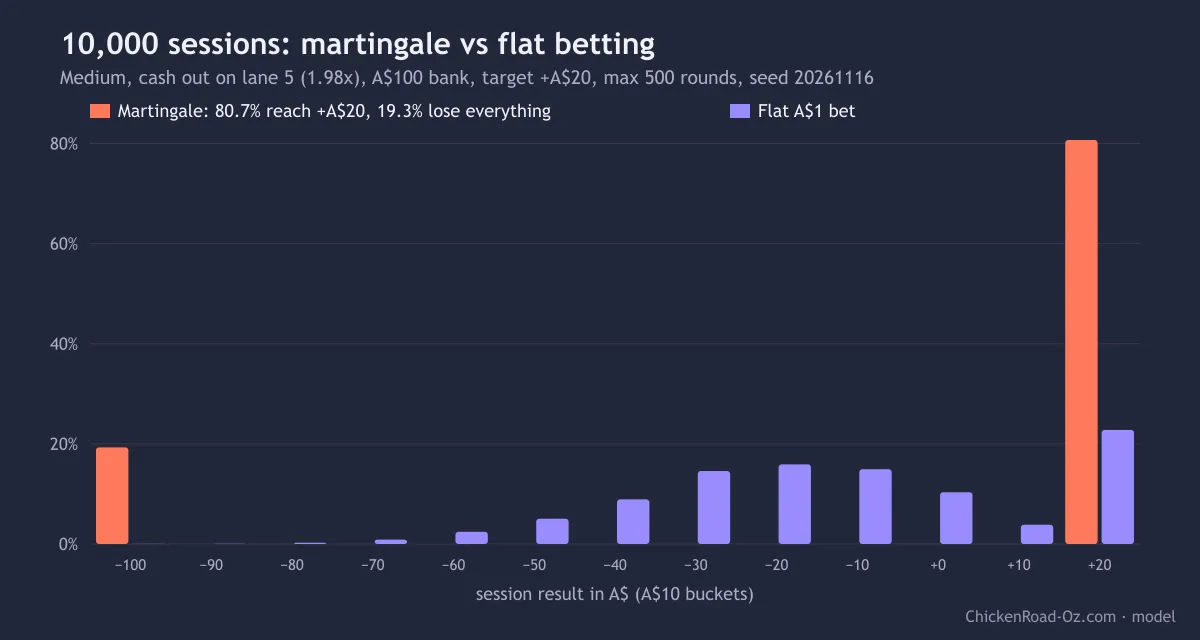
| Martingale | Flat A$1 | |
|---|---|---|
| Sessions reaching +A$20 | 80.7% | 22.8% |
| Sessions losing the whole bank | 19.3% | 0% |
| Average result | −A$2.79 | −A$8.50 |
| Average staked per session | A$159.70 | A$443.40 |
| Lost per A$100 staked | A$1.75 | A$1.92 |
| Biggest single bet | about A$57 | A$1 |
Martingale "wins" four sessions in five. The fifth wipes out the bank, and the average across all sessions is still negative. Flat betting loses more on average only because it plays far more rounds (443 against 46); per dollar staked, both lose about the same small share, as the RTP says they must.
Why the bet runs away
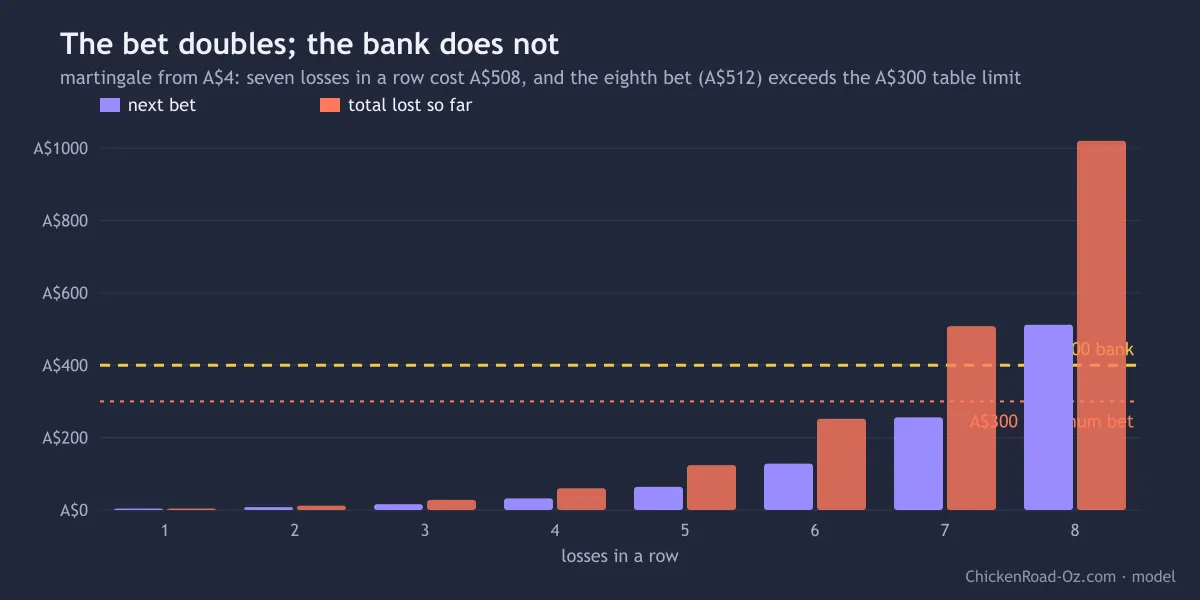
A loss on Medium lane 5 happens 50.4% of the time. Three in a row happen in 12.8% of sequences, five in a row in 3.3%, seven in 0.83%. Over hundreds of rounds, a long streak is not bad luck: it is a near certainty. Starting from A$4, the seventh bet is A$256 and the eighth would be A$512, above the A$300 maximum. With a A$1 base and a A$100 bank, the bank runs out first.
Why it feels like it works
Because most sessions end happy. A player who tries martingale a few times probably wins every time and concludes the system works. The loss comes later, bigger, and is remembered as "bad luck". The simulation shows both outcomes at once: frequent small wins and rare large losses that, added up, still return less than you put in.
Martingale doesn't change the odds, it changes the shape of the loss: lots of small wins, then one bill for all of them.
What to do instead
Nothing beats the return of about 98%; what you can control is how fast you lose and how much you risk. A fixed bet, a budget set in advance and a time limit do more for your money than any doubling scheme. Try your own rules in the simulator on our page about how to win Chicken Road, or in the free Chicken Road demo, where losing costs nothing.
FAQ about martingale on Chicken Road
Does martingale work on Chicken Road?
It wins small amounts often and loses the bank occasionally. In our 10,000 simulated sessions, 80.7% reached +A$20, 19.3% lost all A$100, and the average result was −A$2.79.
Why does the A$300 maximum matter?
Because doubling hits it after seven losses from A$4, or after nine from A$1. Once you cannot double, the system cannot recover.
Is there a better system than martingale?
No system changes the expected return. Fixed bets and limits change how quickly you lose, which is the only thing a player controls.